Research
Papers
- "The gold partition conjecture and the Lexicographic sum of posets" 2026 publication link, arXiv link. With Aldo Guzmán-Sáenz and Sangil Kim. Order. If a finite poset Q satisfies the Gold Partition Conjecture, and P is a finite poset, then for any i in P the lexicographic sum of P with Q on the point i, satisfies the Gold Partition Conjecture.
- "Shuffle series" 2025 publication link, arXiv link, with Khushdil Ahmad and Khurram Shabbir. Journal of Algebraic Combinatorics. We apply the theory of algebras over the operad of posets to solve a problem in enumerative combinatorics. The tensor product of free tree operads can be understood in terms of shuffles of trees, and we explain how to count shuffles between an arbitrary tree and a linear tree. We show that under some conditions, every property of a poset induces three series. We conjecture that every combinatorial experiment related to order, is part of a triple of combinatorial problems.
-
"Polychrony as Chinampas" 2023 publication link, arXiv link, with Jose Antonio Arciniega-Nevarez, Anh Nguyen, Yitong Zou, Luke Van Popering, Nathan Crock, Gordon Erlebacher and Jose L. Mendoza-Cortes. Algorithms.
NOTE: While Algorithms is not on any list of problematic journals, due to the constant spam from MDPI I no longer submit papers to that journal.
In this paper we study signal-flow graphs with a nonlinear condition on the vertices.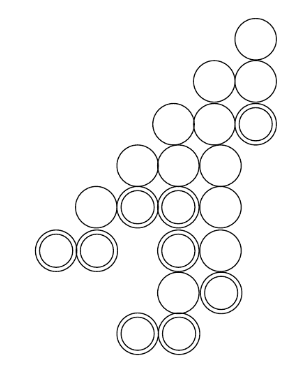 Put double rings on some integer lattice points in the first quadrant of the cartesian plane. From bottom to top, left to right, if coordinate (x,y) and (x,y+1) are have any circles, then put a simple circle on (x+1,y+1). What you obtain is a chinampa. To count certain polycrhony groups we introduce the theory of chinampas and study their enumeration problem.
- "An algebra over the operad of posets and structural binomial identities" 2022 publication link, arXiv link, with Jose Antonio Arciniega-Nevarez and Marko Berghoff. Boletín de la Sociedad Matemática Mexicana. In this paper we study series parallel posets as an algebra over an operad of posets. In our theory, the associativity of concatenation introduces new identities of binomial coefficients.
- I'm coauthor of "Growth of (Re, Pb)-Ca-Ba-Cu-Ag-O Precursor films by spray Pyrolysis Technique", published at the Symposium Solar Cells \& Solar Energy Materials, XIV International Materials Research Congress 2005, Abstracts Book p. 32.
Proceedings
- "Standardization of Post-Publication Code Verification by Journals is Possible with the Support of the Community" arXiv link, accepted at
NeurIPS 2026, with Susana Lopez-Moreno and Sangil Kim. To fight the reproducibility problem in machine learning we explore a pipeline for post-publication code verification that involves journals, reviewers, students/researchers and job interviewers.
NOTE: In machine learning conferences are prefered to journals, and NeurIPS is one of the top 3 conferences in the field.
- "Topological Deep Learning Challenge 2025: Expanding the Data Landscape" 2026 publication link. Proceedings of the 1st Conference on Topology, Algebra, and Geometry in Data Science(TAG-DS 2025), at Proceedings of Machine Learning Research. This is a paper describing the result of a deep learning challenge. My participation on the challenge consisted on designing a new dataset loader in TopoBench for the dataset WS1000_gamma, defined in "Revisiting the necessity of graph learning and common graph benchmarks". The dataset is quite important, as the aforementioned paper's example that for some graph datasets, the features may already include topological information, therefore a nn trained on the features can compete with a graph nn.
Book chapters
- Book chapter : Convolutional Neural Networks Applied to Modification of Images. In: Sriraman, B. (eds) Handbook of Visual, Experimental and Computational Mathematics . Springer, Cham. with Carlos Aguirre-Velez and Antonio Arciniega-Nevárez (2023).
Opinion
- Blog post : A new type of paper mill at https://proofsandprompts.com. When I as a machine learning consultant I realized the problem of automation. So I wrote a story which was desk rejected by a literature magazine. The magazine closed years later due to too many AI generated texts being submitted. Here is my second prediction, this time as a blog post: there will be AI paper mills in mathematics...
Expository papers
- "Operad of posets 101 : The Wixarika posets" 2026 publication link, arXiv link, with Jose Antonio Arciniega-Nevarez and Marko Berghoff. Special Issue on Pakistani Nobel Laureate Prof. Abdus Salam, Journal of Prime Research in Mathematics. This is an expository paper. An old version of these notes were used to give a minicourse in Govt. College University Lahore in Pakistan 2022, and at the BIRS-CMO workshop “6th meeting of the Mexican Mathematicians in the World” 2024.
Ebooks
- EBook : Quantum computing and quantum information A hands-on, continuously updated live book on quantum computing (theory, code, animations and exercises) covering foundations, algorithms, quantum information, error correction and materials. 2026.
- EBook : “Machine Learning For Humans” at the Department of Scientific Computing at FSU 2019.
Preprints
"CheMLFlow: An Open-Source Platform for Cheminformatics and Materials Informatics Applications" link, with Brendan Smith, Susana Lopez-Moreno, Sangil Kim, Jose L. Mendoza-Cortes, and Nijamudheen Abdulrahiman. We propose a ML pipeline compatible with agentic coding. This project is a step towards reducing the reproducibility problem in science and reducing problems with the use of AI agents. While focused on Cheminformatics, it can be applied to other areas of AI.
"PCA-Enhanced Adaptive NVAR Framework for High-Resolution Sea Surface Temperature Forecasting in the East Sea" link, with Azimov Sherkhon, Susana Lopez-Moreno, JinYong Choi, and Sangil Kim. We modify our Adaptive-NVAR to estimate sea surface temperature.
"Adaptive Nonlinear Vector Autoregression, Robust Forecasting for Noisy Chaotic Time Series" link, with Azimov Sherkhon, Susana Lopez-Moreno, Sieun Lee, and Sangil Kim. We create a neural network (based on NVAR) to estimate time series from caotic dynamical systems with noise.
- "Order Theory in the Context of Machine Learning" link, with Aldo Guzman-Saenz, Sangil Kim, Susana Lopez-Moreno, and Jose Mendoza-Cortes. We conect order theory with ML, discovering new pooling filters that sometimes outperform max pooling, average pooling, and mix pooling.
NOTE: Poster presentation at NeurIPS WIML 2024.
- "A poset version of Ramanujan results on Eulerian numbers and zeta values" link, with Jose L. Mendoza-Cortes. Consider the decomposition of a cube into 6 pyramids. When we put them togeter, we double count 6 triangles, and when we remove those triangles, we had to return a line. This leads to an inclussion exclusion formula cube=6pyramids-6triangles+1line. From that formula we describe an identity among zeta values. We then show that this process: decomposition of polytopes-> identities with zeta values is true for order polytopes of posets. This is generalization of an identity by Ramanujan and our techniques compute new rational zeta series.
- "Convergence of Taylor Series of real normed division algebras". link. In this paper we demonstrate how to extend the Cauchy-Hadamard theorem to quaternionic analysis; the methods allowed us to prove a couple of Abel's theorems about convergence of (hyperholomorphic) series and to find a bigger region of convergence than the standard sphere.
Translations
- Curriculum translated :Currículum para una clase de ética en inteligencia artificial para estudiantes de secundaria. (Traducción al Español junto con Antonio Arciniega Nevarez, Mariana García Prince y Karina Dolores Cuenca)
- Paper translated : “Sobre algebras quasitriangulares quasi-Hopf y un grupo estrechamente relacionado con Gal(bar{Q}/Q)” Traducción al Español de “On quasitriangular quasi-Hopf algebras and a group closely connected with Gal(bar{Q}/Q)” de V. G. Drinfel'd.
Open problems
- Mikhail Safronov and I conjecture that 49x2^n has always an odd digit.
- Enumeration of Chinampas of profit bigger than 1 : click here to download brochure.
Others
- Consultation with the Department of Geography at FSU: Organized and hosted bimonthly meetings to discuss possible ML projects with geographical data.
with Dr. Dmitry Tamarkin. I am intrigued by the theory of Drinfeld associators, so I organized a seminar called
“Associators, Formality and Invariants” where I talked about EK-quantization of Lie bi-algebras, Homotopy Gerstenhaber algebras and formality,
among other topics. “Associators, Formality and Invariants” Seminar at Northwestern University.
Below are some notes from the seminar. Notes from Dr. Licata's course : Braid group actions from representation theory).
My own notes on A infinity algebras.
My own notes on Genus-zero TQFTs and operads.